12 March 2007

Final Post and Introduction

This is my final post to this blog and in it I aim to present a small summary of the concept of yoga as I understand it after my experience in India, because I believe a lot of people are confused by all the different styles of yoga and do not clearly understand that yoga is not just a form of exercise. This little summary might not be completely correct and it might give rise to some discussion or constructive criticism, which I appreciate. This summary can be used as an introduction into my blog and after you have read it, I suggest you read the posts from oldest to latest, unless you are looking for something specific, in which case you can use the specific labels, which you will find on the right hand side.

What is yoga?

Literally yoga means "union" or "to yoke". Yoga is the union of breath with the body, of the mind with the muscles, and the self (or soul) with the divine. Yoga is not a religion and does not require you to believe in a certain God or chant certain mantras. It is an ancient Indian discipline which leads to health in the body, peace in the mind, joy in the heart and liberation of the soul. Liberation of the soul? In this context, I believe liberation of the soul does not mean union with the divine after death, but liberation from anger, greed, worry, desires, despair and depression.

Often the reason for our unhappiness on a personal level is the fact that we are constantly at odds between our mind and our heart, our desires and our fears. We feel alone, anxious and scared.
In our families and communities we criticize each other and compete with each other, "My style of yoga is better than yours." And we devide ourselves by nations, religions and colour. Yoga in its most complete meaning is the panacea for all that which ails us and devides us.

Here's a dictionary definition of yoga:
Yoga: n 1: Hindu discipline aimed at training the consciousness for a state of perfect spiritual insight and tranquility that is achieved through the three paths of actions and knowledge and devotion
2: a system of exercises practiced as part of the Hindu discipline to promote control of the body and mind [Hindi, from Sanskrit yoga, union, joining.

Note the paths of action, knowledge and devotion. There are many types of yoga that don't even include doing poses like down dog or tree. This is because yoga is not just physical exercise. There is yoga that only focus on obtaining knowledge of sacred texts. There is yoga that is all about devotion and service.

Types of Yoga

  • Hatha Yoga
Most people if you ask them what kind of yoga they do, will say "Hatha Yoga". A lot of people get confused as to what all the different kinds of yoga are.
Hatha literally means "sun meets moon" and this type of yoga emphasizes specific physical postures or asanas. The ultimate goal of practicing difficult postures, however, is not a toned bum or flexible hamstrings, though these are sometimes the by-product of a yoga practice. The ultimate goal, if we are to really do yoga, is to force the mind to withdraw from the outside world to create perfect spiritual insight and tranquility. Hatha yoga provides us with a healthy body, which is a stepping stone towards achieving a still mind.

There are many different styles of yoga:
Anusara, Ashtanga, Bikram, ISHTA, Iyengar, Jivamukti, Kripalu (derived from Kundalini), Kriya, Power, Restorative, Shinto, Sivananda, Vinyasa (Flow).
These are all forms of Hatha yoga and I suggest people try out different styles to find one that suits them. There is a good comparison of the most popular styles / kinds of yoga in the February edition of the Yoga Journal.

Ashtanga yoga was and is taught by Pattabhi Jois in Mysore, India. A few decades ago westerners started going to Mysore to practice with Jois, or Guruji, as he is called. They brought the practice to the U.S., Europe, well now pretty much all developed countries have ashtanga yoga. Guruji, now at 91 years of age, is not the only ashtanga teacher in India, but he is by far the most popular.
Iyengar yoga is called Iyengar after the instructor who popularized this type of yoga. BKS Iyengar, who is also in his 90's, teaches in Pune, India.

BKS Iyengar and BNS Iyengar, along with Pattabhi Jois, learnt yoga from their guru Sri T. Krishnamacharya. While Jois and BNS today teach the vinyasa based form of yoga known as ashtanga, BKS focused on breaking down postures and working on the alignment. Iyengar yoga is sometimes referred to as "prop yoga", because of the use of props such as blocks, straps and blankets. If you are a detail oriented person, who doesn't mind a lot of verbal instruction by the teacher, Iyengar yoga may be the thing for you and it is a great base for understanding alignment. It can also be a good choice if you are practicing with injuries.
  • Japa / Mantra Yoga
This form of yoga involves the use of words or phrases that are repeated either mentally or verbally.

  • Karma Yoga
This is the first of the vedic methods recommended for self-realization. It is the path of selfless action, in which the practitioner serves others without expecting anything in return.

  • Jnana Yoga
This is the path of knowledge in which the practitioner seeks the answers to questions such as "Who am I", through science and philosophy. Ghandi never did any asana's, yet he was a model yogi on this path.

  • Bhakti Yoga
This is the path of devotion and is considered the superior method for achieving self-realization, when compared to Karma and Jnana yoga. Priests, monks, nuns and other holy people all follow this path.

  • Raja Yoga
Raja Yoga means the king of yogas and is based on the yoga sutras written in sanskrit by Patanjali some 2800 years ago. Yoga is believed to be a lot older, and there are many other sanskrit texts on the subject which have been lost, such as the yoga korunta.
The yoga sutras explain yoga as an eight-limbed tree. Ashtanga means "eight limbs", but when we refer to Ashtanga Yoga, we all mean the practice of the asanas, which is only one limb. When Pattabhi Jois named the style of yoga he developed, from what he learned from his guru, he meant it as a reminder to practice all eight limbs and not just the asanas. Yoga is a way of life and its teachings should penetrate every aspect of our being from your actions to your speech to your thoughts.

There is a style of Yoga called Integral yoga, which integrates the various branches / forms / types of yoga mentioned above.

The eight limbs of Raja Yoga

There are many many translations of the yoga sutras and I have tried to identify, through discussion with people who have read some of them and by reading reviews on them, the most easily readable translations. I have put links to two of the ones I have identified as easily readable on the blog on the right hand side.

As mentioned earlier, yoga is not a religion and none of the eight limbs depends on one's spiritual belief system and it does not matter what name or form of the divine you worship.

The first four limbs are considered the external limbs, and the last four limbs the internal limbs.???? The order of the limbs is important and the first two limbs are the foundation of the "tree", the moral and ethical code of conduct.

1. Yamas (actions)
a) Ahimsa: non-violence
b) Satyam: truthfulness
c) Asteya: not stealing
d) Brahmacharya: restraint and moderation
This is frequently translated as celibacy or abstinance, but after more research, I found the following description: one whose actions are pure and holy, to create loyal, honest and loving relationships bringing us closer and closer to God.
e) Aparigraha: non-accumulation/non-hoarding
"There is more than enough for everyone's need, but not enough for any man's greed." Mahatma Ghandi. We need to realise that nothing belongs to us, we are merely lending it for certain period of time, and the more we try to accumulate, the more we acquire, the more we are bogged down and the more difficulties we face.

2. Niyamas (observances)
a) Suacha: refraining from putting anything impure into our being (drugs, cigarettes, negative gossip, pornography etc)
b) Santosha: contentment
We should strive for an attitude of gratitude instead of hungering for more (possessions and achievements).
c) Tapas: practice of tolerance
taking control over our volatile mind, emotions and insatiable senses
d) Swadhaya: study of the scriptures
We should read something spiritual and inspiring every day, but we should also use introspection as a tool to examine our lives, just like a businessman examines his balance sheet.
e) Ishwra pranidhana: devotion to God

3. Asana (Seat on which to sit to practice yoga - control of the body)
Asana (or the physical posture) is not the yoga, it is the preparation for the practice of yoga. We must not stop with asana, the asana readies us for the higher limbs of yoga.

4. Pranayama (prolonging our life force and energy - control of the breath)
As the breath becomes still, slow, deep and steady we find that our lives also become calm, collected and centred.

5. Pratyahara (withdrawal of the senses - control of the senses)
Turning the object of our senses from the external to the internal.

6. Dharana (singleminded concentration - control of the mind)
To channel all thought-power in one direction and stop the incessant wanderings of the mind.

7. Dhyana (meditation)
Not to be confused with concentration, where there is a subject (you) and an object (what you are concentrating on). In meditation all borders, boundaries and seperation between the universe and us begin to disappear and we begin to realise the inherent oneness of all beings and all creation. At first we will need a technique to get us there, but once we are in a meditative state, we do not need a technique any more.

8. Samadhi (to merge)
This is the ultimate goal of enlightenment.

10 March 2007

Rishikesh

Namaste, this is your cross legged guru coming from the yoga capital of the world... Well that is what Rishikesh calls itself, and this is with some justification, because there are a multitude of ashrams, not just shala's where you practice yoga, but ashrams where you live and do yoga, lining the ganges river banks and hugging the slopes of the foothills of the Himalayas. Even the hotels have got daily yoga sessions taking place at the hotel, which outsiders can also join for a fee of about Rs 100.

So let me start from the beginning. On Wednesday, the 7th of March, I left McLeod Ganj and got on the bus in Dharamsala for Dehra Dun, which was supposed to be a 12 hour trip. We left at 17:30, but only arrived in Dehra Dun around 13:00 on Thursday, due to the fact that the bus got a punctured tire sometime after midnight. I was snoozing and only got out of the bus to see what was going on around four or five am. By that time they were busy putting a spare tyre on but I do not know what took them so long. When we finally got going we went to get the tyre that was just put on, replaced... I have a suspicion that the tyre was borrowed. Well we finally got going again after seven.

When we arrived in Dehra Dun, people started getting off at different places until only three tourists (including myself) were left and the bus driver decided to drop us off in the middle of some busy intersection (I guess he wanted to get rid of us so he could get some shut eye), so the three of us had to catch bus number 5 to the ISBT (Inter State Bus Terminal), which we found out by asking the shop keepers around us. The "bus" was more like the rickshaws used in Malaysia and Thailand, slightly bigger than the black and yellow kerosene burning rickshaws used in India, and it has 2 bunks on which you can seat 3 people each. It was not fun in the midday heat with all my baggage and the fact that I had felt nauseaus since I got onto the bus (I think it was the fried BakLek I had at the restaurant before leaving - I won't be looking at any more fried food in a while!) and had not eaten since did not help. I eventually stopped a "bus" that was not completely packed and got on with all my gear. It ended up being almost half an hours drive to the ISBT, which I did not expect and the "bus" filled up very quickly until we were squashed in with 4 on each bunk and all my gear on other peoples laps...

At the ISBT I caught a local bus to Rishikesh, which was another one and a half hours away, and was another terribly squashing experience. I was alone now even though the other 2 tourists were also going to Rishikesh because we could not all fit on "bus" number 5.

So I eventually got to Rishikesh just before 16:00. I had intended getting there early in the morning and hoped to do some yoga during the day, but it was not to be. I had gone through the lonely planet and found the conglomeration of ashrams I found most interesting. Getting off the bus I had the usual trouble with rickshaw touts and walked two or three hundred metres away from the bus station where I was still charged 4 times the price locals pay (Rs 5), but it was still only two thirds of what I would have paid at the bus station.

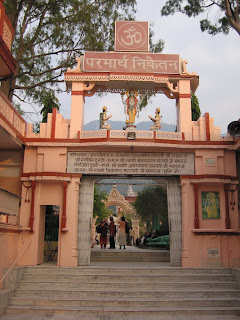
It took me a while to finally decide on an ashram. Along the way I met people staying at the Shivananda ashram who told me that the yoga there was not so nice and they were actually looking for an afternoon yoga session at another ashram. We crossed the pedestrian bridge over the holy river "mother" ganges, and looked at 2 ashrams on the other side. The girls ended up joining the yoga class at one of them, even though they were half an hour late. I decided to go to the previous ashram we had looked at, the Parmarth Niketan Ashram.

In India, so many things happen by coincidence... I found out later that this was the largest ashram in Rishikesh with over 1000 rooms, and on arriving I found out that the International Yoga festival had just taken place here from the 1st to the 7th of March. If I had known, I would have come to Rishikesh instead of gone to McLeod Ganj... anyway, will have to do this another time.

I had to wait quite some time to be helped, but I eventually got a room for Rs 400 a night, which includes all meals and all the yoga sessions at the ashram... Excellent!
At 18:00 until 19:00 every evening there is aarti at the banks of the ganges, run by this ashram. Aarti is prayer ceremonies and is basically lots of singing and clapping hands sitting at the ghats (steps down to the river). According to the literature here it is world famous and it was quite a pleasant experience.
After that we had supper, which was thali. I was actually looking forward to rice and dal, as I had not had any since I left the south of India.
The gates to the ashram close at 22:00, and the town is actually dead by that time because all the shops close between 19:00 and 21:30.

Friday
I got up in time for the seven o'clock Iyengar class with Karin O'Bannon, which was quite good, but typical of the Iyengar style, she took one single pose, the warrior pose, and we worked on that for the entire one and a half hours, just perfecting alignment. This is a great complement to Ashtanga yoga in my opinion, but of course you never ever break into a sweat. Straight afterwards I went to the Kundalini Yoga session until ten o'clock. This was a more energetic class and includes lots of chanting and the movements are timed, but I did not enjoy Kundalini very much.
At the end of class someone called my name and guess who happened to be at the same ashram in India... it was Kerry, the owner of the Haum of Yoga in Johannesburg. As breakfast time at the ashram was over, we went to a nice little restaurant outside and caught up with each other. Kerry had come to India specifically for the International Yoga Festival and told me more about it. She wants to get a group of South Africans to go together next year. She also said that the Kundalini Yoga during the festival was much much better and was led by Gurmukh Kaur Khalsa, a sentiment I had heard before too.

Kerry also made an insightful comment that I thought I would share. There are seven chakras along the body's axis. We were discussing how difficult it is to travel in India and she explained that while travelling in India you are operating from your root chakra, because you are always on the defensive, and therefore it is very difficult to operate from your heart chakra and be
open and loving to others.

Lunch at the ashram was another simple thali with rice, dal, a vegetable, chapati and some pickled mixed vegetables (achar) which I enjoyed. At three o'clock I said good-bye to Kerry, as she was leaving for Delhi and I gave her the biltong I had been carrying since the beginning of my trip (I have been living on a pure vegetarian diet since arriving at Purple Valley) as she wanted to give it to a South African friend in Delhi.

At 15:30 I did another yoga class which focused on backbending. It was the first time I had ever gone into the full back-bend without having generated all the internal heat through the ashtanga yoga sequence.

Supper was another Thali with different vegetables and was very good again... I really enjoyed the food at the ashram even though it was very very simple.

Saturday
My last day at the ashram. A very unexpected rain shower woke me up in the early hours of the morning. I then joined the satsang at 6 o'clock, which basically consisted of meditating for an hour while the sun was coming up, listening to chanting music in the background and a candle lit in front of us. There were only three of us at the session.

The next available class was the Kundalini at 8:30, but I decided to go look at the yoga at
another ashram. I watched as they started and decided not to join as it was just too calm and easy for my taste. I ended up spending four hours on the Internet working on the blog and then had lunch at the ashram... guess what it was... Thali... but I enjoyed it again.

After lunch I decided to explore the town more and strolled up to Lakshman Jhula (pedestrian bridge) and further up along the ganges and then turned back and crossed the ganges on the bridge, walked back down the other side and crossed back over on the Swarg Ashram Jhula. This was about a three or four hour walk, during which I saw many signs for a 7 day Ashtanga Yoga retreat.
On the way I bought some gooseberries. I did not expect to see gooseberries in India and when asked what it is, the locals call them raspberries and cherries and who knows what else, because they don't know the English name. I then realised that there were monkeys around and quickly had to make an escape, only to realise that where I was now standing on the street there were two more monkeys watching me from the roof of the building. So I ate them very quickly.

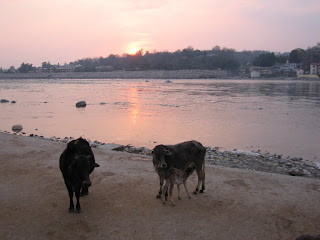
A quick comment on the holy cows... They are everywhere, even crossing the pedestrian bridges, and of course they shit everywhere, so you have to watch where you step ALL the time. In the mornings some hay gets put out by the ghats next to the river, but after that the cows forage in dustbins etc around town. I have heard that they sometimes die from eating plastic packets and I have personally seen a cow literally eat the posters off the walls using its tongue to tear pieces of paper away.

After the walk I bought another four books at a great little store that gave twenty percent discount on top of the very cheap prices. I then joined the evening aarti at the ashram again and then headed off to my room where I showered and got ready for my forty hour trip back home. During that time, the heavens opened up again and I was looking at a very wet trip to the bus station. I went and had another Thali for supper.... mmmm... I love this ashram... another full belly and I am ready to leave.
I asked the guys if there was anyway to have a taxi come pick me up at the ashram because of the rain, but this was not possible, because there are NO bridges for cars!!! Luckily the rain had died down and I did not get too wet hiking to the other side. I was wearing my shorts and long pants as well as a t-shirt, long-sleeved top, and wind breaker, even though it was not very cold. This was only to ensure that I could fit all my stuff into my bags. I had also donated my towel and some other t-shirts to the ashram.

On the other side I had to bargain for a taxi to the bus station because with the rain, the taxi driver was not going to be able to pick up any other passengers. The bus was supposed to leave at 21:30, but I got there at around 20:50, just in case it left early. I could not afford to miss any of my modes of transport from now on. My bus was scheduled to arrive in Delhi after four in the morning and there was no other bus that evening. The bus the next day would have been too late to catch my flight to Mumbai, which left at 14:00.
I was however quite undisturbed if any of my modes of transport were delayed, because I did not relish the thought of arriving at four am in Delhi and I had plenty of time to spare in between. As it turned out, the bus we were all waiting for at the travel agent never arrived, so the travel agent quickly packed the seven or eight of us into two taxi's and took us to the bus station where there was pandemonium because people had paid for sleepers and were not getting sleeper seats etc. I was refunded the Rs 250 I had paid and paid Rs 200 to the conductor on this bus. I was relieved that I did get a seat though, because the bus was full!!!

Sunday
We arrived in Delhi around five in the morning and I read my Lonely Planet to figure out what I would do until it was time to go to the airport. I decided to go look for a yoga or meditation class in the city and afterwards have breakfast and then do some final shopping.
I left my big backpack at the cloak room at the bus station and then took the Metro for Rs 9 to Connaught Place.
I had chosen to visit the Morarji Desai National Institute of Yoga, and guess what I found when I got there. They are holding a National Yoga Week from the 12th to the 16th of March. It would have cost a mere Rs 1200 for the entire week, including accommodation and meals... That is incredibly cheap. But the fact that there is so much happening around yoga wherever I look, makes me think that yoga is well and alive in India!!!
There was unfortunately no classes that I could attend because everybody was apparently preparing for the yoga week.

So I headed back to Connaught Place to find a restaurant serving up some good south indian breakfast... my last chance :-). I found a restaurant that was open at 8am on a Sunday morning and was recommended by the Lonely Planet. However, the idli's were tiny, the dosa was too thin and Delhi was extremely expensive. I remember having breakfast with Ayu at a restaurant in Mysore and we had four plates of idli, and three plates of dosa and four cups of chai and it all came to about Rs 58. One plate of tiny idli's here cost Rs 45.

After enquiring what the best option would be to get to the airport, I headed back to the bus station to collect my bag. I got back to Connaught place around 10:30 when some stores started opening up, but most remained closed because it was Sunday. I started searching for masala chai... spices for the tea in India. As Connaught place was not a residential area and had no general stores, only brand stores, I was very unsuccessful in finding tea spices.

At around noon I looked for a public bus to the airport but was unsuccessful as well and eventually resigned myself to having to pay about Rs 250 for a rickshaw. Luckily I found a very helpful gentleman who told me to wait in the building, while he got me a rickshaw for the true price of Rs 60 or 70. Eventually I got a rickshaw for Rs 90, plus Rs 10 for the bags, which I was very happy with. On the way to the airport I struck a deal with the rickshaw driver to make a detour to some shops to buy Masala Chai.

My flight was slightly delayed and we arrived in Mumbai just before five in the afternoon, but I was very impressed again with the service on Jet Airways and the food. We were served Baskin and Robbins ice cream after lunch, so I had three helpings :-)
After I got my bags, I took the shuttle transfer to the international terminal where I had to spend seven hours waiting. This is the same terminal where I had spent the first few hours of my trip (when I arrived in India) waiting until morning. The food in the terminal was extremely expensive at four times the price on the street, and so was the internet cafe.

At midnight I joined the long queue to have my bags security checked and they actually asked me to open my backpack to get my alarm clock. They took out the battery, so that the clock would not tick. The aeroplane was new and big and more spacious than any of the domestic flights I had been on, but the service on SAA was not very good. I did not have anyone sitting next to me, which was lucky as the flight was 95% full. We landed at 7:15 and I was happy to be home.